
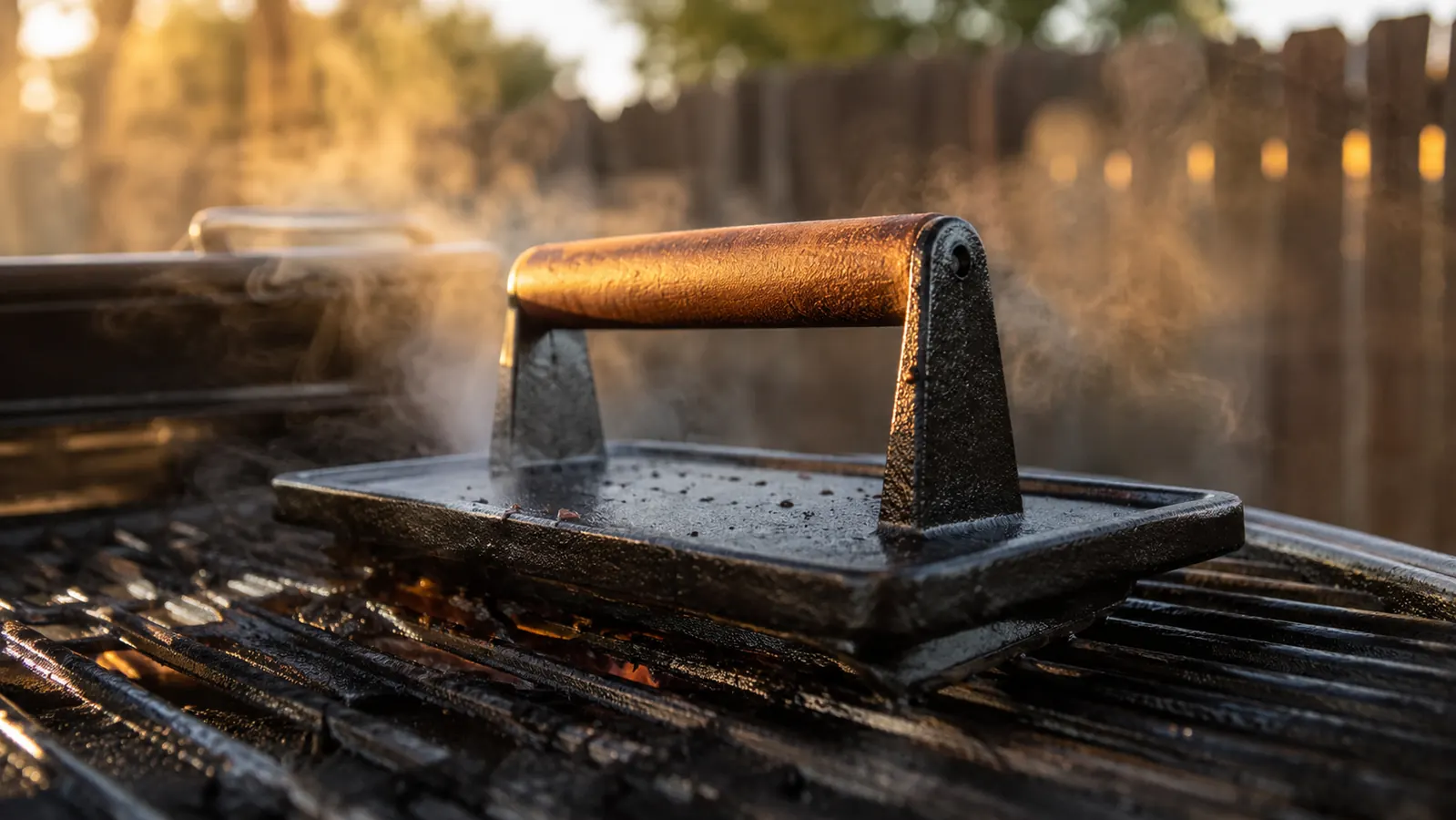
I've had my Cuisinart cast iron grill press sitting on the shelf next to my spatulas for going on three years now, and I still get asked about it more than any other tool in my kitchen drawer. Folks see the crust on the smash burgers I bring to a potluck and want to know what I'm using. Here's the thing nobody tells you before they buy one: it's a genuinely good tool, but it's not the miracle gadget some of the glowing five-star reviews make it sound like. I want to give you the version of this review I wish somebody had handed me before I bought mine, warts and all.
This Cuisinart press has a rectangular cast iron base with a rounded wooden handle riveted straight through the top, and it comes in right around two and a half pounds, heavier than most folks expect from the product photos. That extra heft is exactly why it puts down such a good crust, but it's also the first thing that catches people off guard, especially if you've got some arthritis in your wrists like my neighbor Carl does, or if you're flipping with one hand while pressing with the other. I'll walk through all of it, the good and the annoying, but let's start with where I landed after three years of actual use.
The Quick Verdict
A genuinely great smash burger and bacon press that earns its keep in a real kitchen, just don't expect it to be light, cool-handled, or maintenance-free.
Amazon Check Today's Price →Tired of Foil Bricks Warping Mid-Flip and Flat-Bottom Spatulas That Don't Actually Flatten Anything?
A real cast iron press holds its heat and its shape, cookout after cookout. See today's price and current availability on Amazon before you settle for another workaround.
Amazon Check Today's Price on Amazon →How I've Used It
I bought this Cuisinart press the same week I set up a flat top griddle station next to my regular grill, mostly because I'd seen enough smash burger videos online to get curious. Since then I've used it, by my rough count, somewhere north of two hundred times. Reunion cookouts, Sunday breakfasts, the occasional Tuesday when I just wanted a good burger. It's seen bacon, smash patties, the occasional grilled cheese pressed flush against a cast iron skillet, and one memorable attempt at flattening a chicken breast that honestly worked better than I expected.
I didn't test this thing in a lab. I tested it the way you actually would, on a real griddle, in real weather, with grease popping and grandkids underfoot asking when the burgers would be ready. That's the review you're getting. Not a spec sheet, a real accounting of what it's like to own one of these for a few years.
What surprised me most wasn't how well it worked on day one. Plenty of tools look good the first time. What surprised me was how consistent it stayed after dozens of uses, once I understood how to actually take care of it. That last part matters more than most reviews let on, and I'll get to it.
I also ran a rough side by side one Saturday, cooking half my burgers with the press and half with just a heavy metal spatula pressed twice as hard, on the same griddle, same beef, same five minutes apart. The press patties came out flatter, more even, and browned corner to corner. The spatula patties had a decent crust in the center but stayed pale and thick toward the edges. It wasn't a scientific experiment, just two batches of burgers on a Saturday afternoon, but it settled the question for me and for my son, who did the taste test blind and picked the press patties every time without knowing which was which.
What the Cast Iron Actually Does That a Spatula Can't
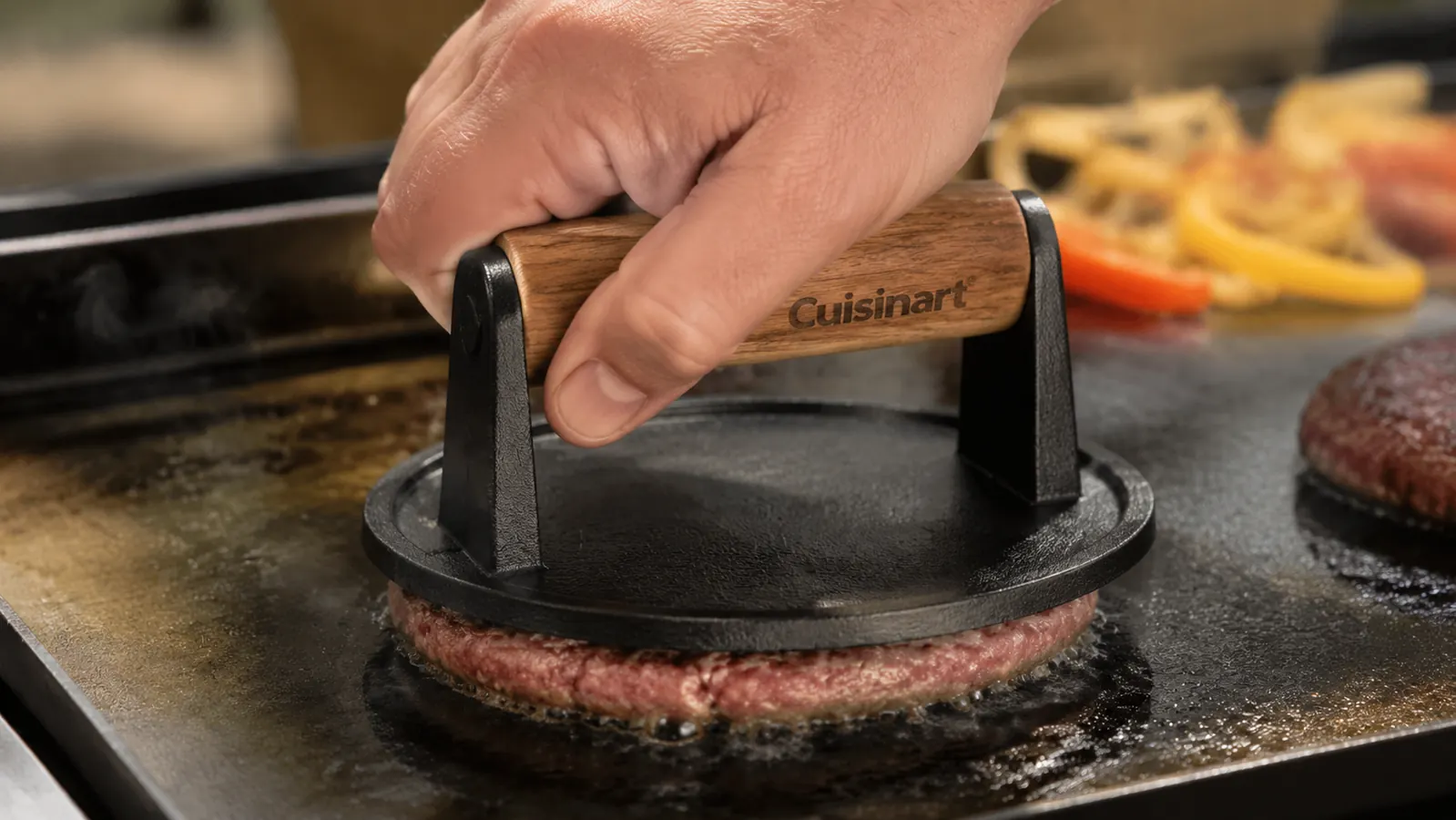
Here's the honest mechanism, because I think people buy this without really understanding why it works. Cast iron holds a huge amount of heat relative to its size, and it releases that heat slowly and evenly across the whole surface it's pressing against. When you press a smash burger with the back of a spatula, you're pressing with a thin piece of metal that cools down fast and doesn't distribute pressure evenly. You end up with a patty that's flat in the middle and thick at the edges, and a crust that's spotty instead of edge to edge.
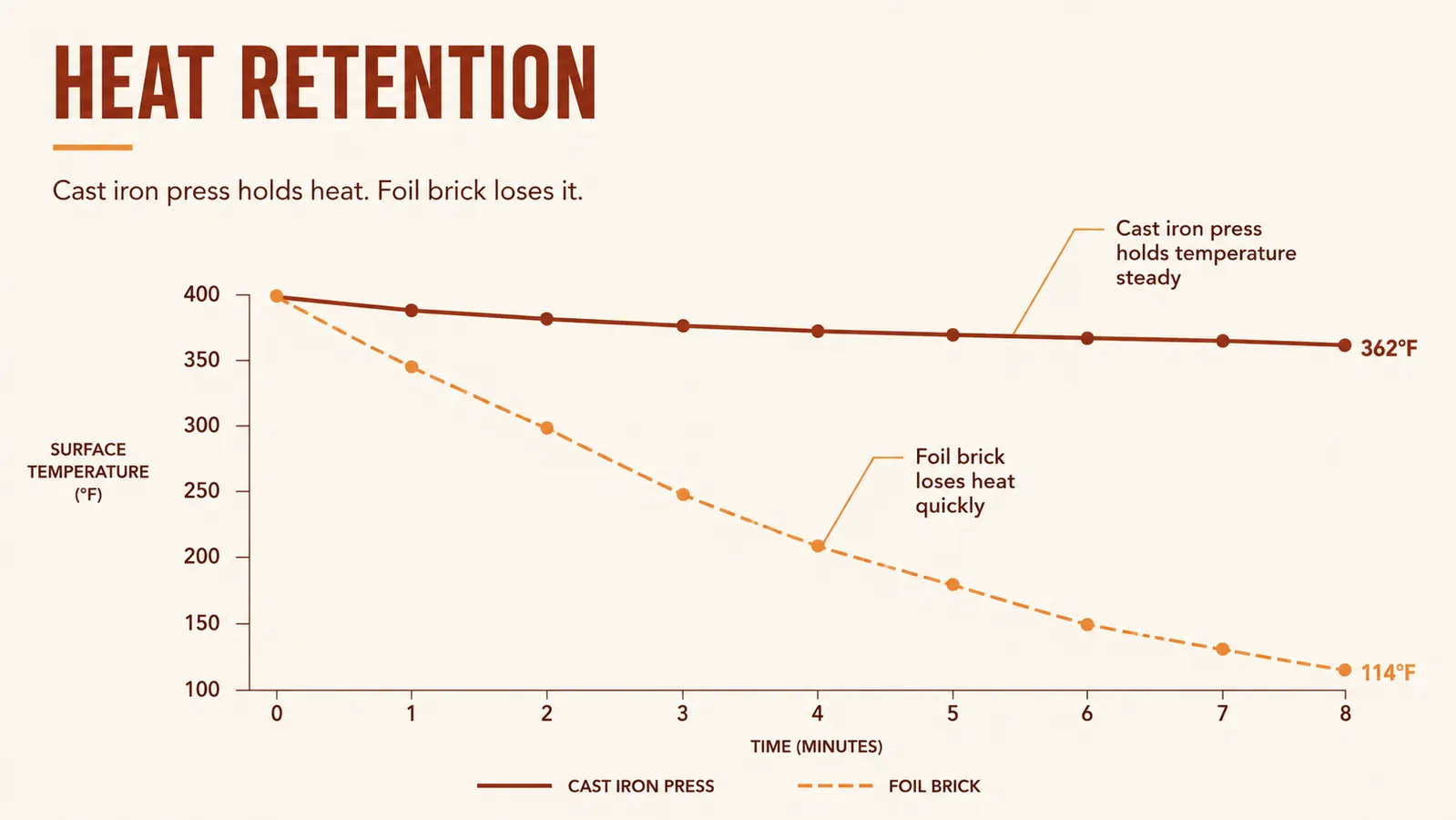
The Cuisinart press solves that because the base is heavy enough to stay hot through the full press, and flat enough to make contact with the whole patty at once. I've measured it informally with an infrared thermometer, pressing straight off a preheated griddle, and the surface temperature barely dropped during a five second press. A thin spatula loses a noticeable amount of heat in that same window. That's the whole trick. It's not magic, it's just mass and surface contact.
Where this actually shows up on the plate is the crust. A properly smashed patty with this press gets what people in the burger world call lace, that crispy webbed edge of browned beef that a regular spatula just can't reliably produce. My oldest son, who is skeptical of basically every kitchen gadget I own, admitted after one bite that the crust difference was real and not just me talking up a purchase.
The same principle carries over to bacon, which honestly might be where I use this press more than anything else. Regular bacon curls up as it cooks, shrinking unevenly and leaving you with strips that are crisp in some spots and floppy in others. Press it flat right when it hits the griddle and hold it there for the first minute or two, and it cooks dead flat all the way through, edge to edge crispy without babysitting it with tongs the whole time. That one use alone, bacon for a big Sunday breakfast crowd, might be worth the price of admission even if you never make a single smash burger.
The Weight Nobody Warns You About
Now for the part most reviews skip. Two and a half pounds doesn't sound like much until you're pressing your eighth patty in a row at a family reunion, one hand holding the press, wrist locked, leaning your body weight into it because that's really what gets the best sear. By the time I've done a dozen burgers for a crowd, my forearm knows it worked. It's not painful, but it's real fatigue, and if you've got any wrist or grip issues, this is worth thinking about before you buy.
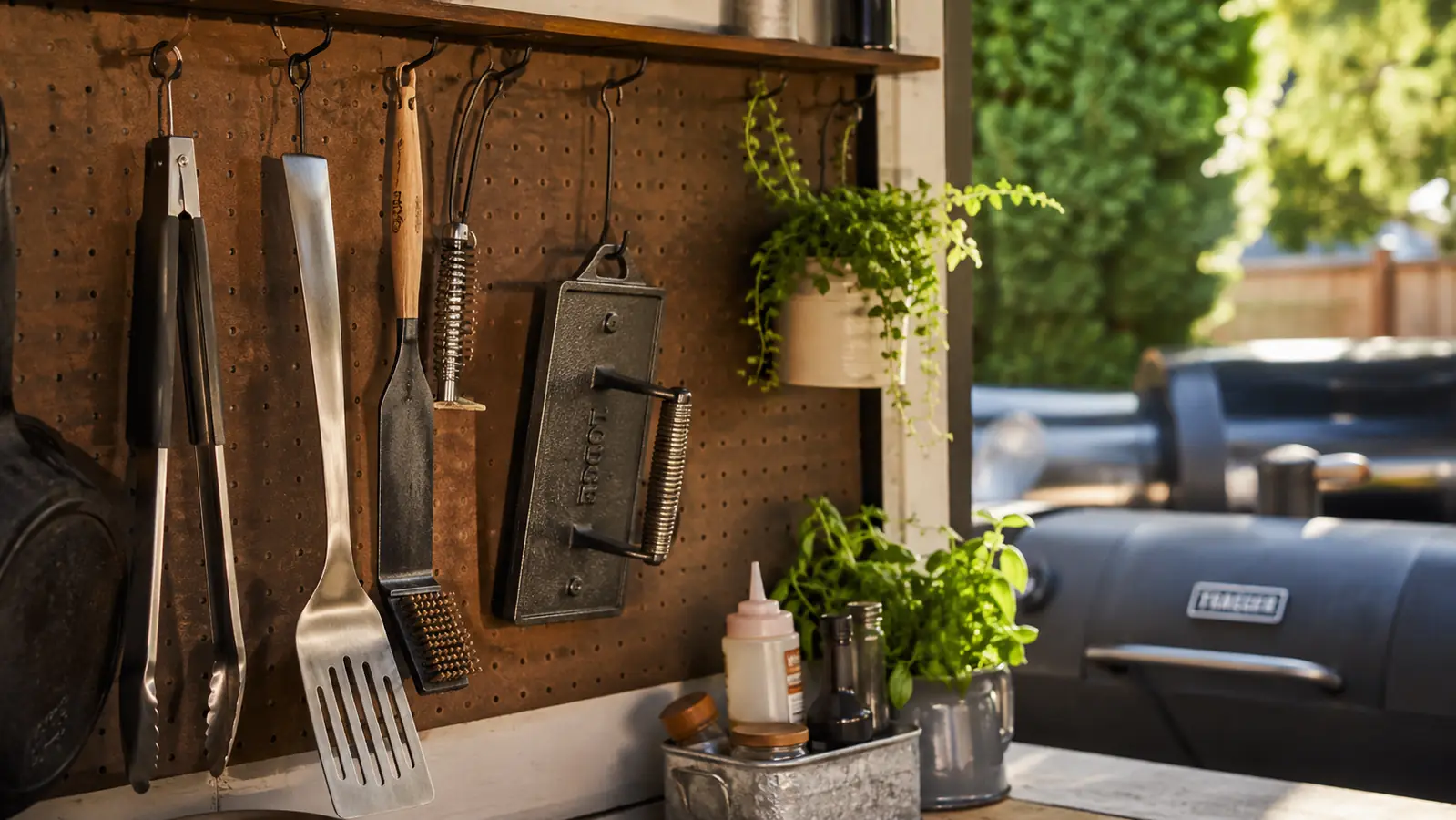
The weight also matters in storage, which is a dumb thing to have to mention in a review but it's true. This isn't a tool you toss in a drawer with your spatulas. Mine lives on an open shelf because it's heavy enough that I don't want it sliding around and denting something, and I've dropped it on my foot once reaching for it in a hurry. It hurt. I'm telling you that because nobody puts foot-dropping incidents in the marketing copy.
My wife Donna won't use it at all, not because it doesn't work, but because she says it feels like lifting a small dumbbell every time she presses a patty. That's a real consideration if more than one person in your house is going to be using this thing regularly. It's not built for someone who wants a light, easy tool. It's built for leverage and mass, and that's a tradeoff, not a flaw exactly, but a real one.
My grandkids have tried to use it exactly once, under close supervision, and it didn't go well. Not because it's dangerous exactly, but because a seven-year-old doesn't have the arm strength or the wrist control to press evenly, and you end up with a lopsided patty and a kid who's frustrated. This is squarely an adult tool. If you were hoping it might be something the kids could help with at a cookout, temper that expectation now.
The Handle Heats Up, and Other Small Annoyances
The wooden handle stays cooler than a metal one would, that part is true and it's genuinely nice. But the metal rivets that hold the handle to the cast iron base get hot enough to surprise you if you grab the press wrong, right up near where the wood meets the iron. I've caught the edge of my palm on those rivets more than once reaching for it too casually straight off a hot griddle. A folded towel or a silicone hot handle sleeve solves it, but the box doesn't warn you, and I wish it had.
There's also the grease situation. Press down hard enough to get a good crust and you'll get grease squeezing out the sides, sometimes up toward your wrist if you're not paying attention to the angle. It's not a design flaw, it's just physics, but it caught me off guard the first few times, and I've got a couple of small grease burns on my forearm to prove it. Now I press at more of an angle, pushing away from my body, and it's a non-issue.
One more small thing worth mentioning honestly. Mine came with a very slightly uneven base, nothing dramatic, but if I press on a perfectly flat surface I can feel a tiny rock to it. It hasn't affected the cooking in any way I can point to, but I've seen a few other owners mention the same minor inconsistency, which tells me casting quality varies a little batch to batch. It's a minor gripe, not a dealbreaker, but an honest review should mention it.
Seasoning and Cleanup: The Real Maintenance Picture
This is cast iron, which means it behaves like every other piece of cast iron in your kitchen, and that surprises people who expect a modern nonstick tool. It needs to be seasoned before first use, and it needs a light coat of oil after every wash or it will flash rust, sometimes within a few hours if you leave it wet on the counter. I learned this the hard way after leaving mine to air dry overnight the first month I owned it. Woke up to a faint orange bloom on one corner.
It is absolutely not dishwasher safe, despite what a couple of comments online seem to assume. Hand wash only, dry it immediately, hit it with a little oil, and you're fine. Once that becomes routine it takes maybe an extra ninety seconds per use, which isn't a big deal to me, but if you're the type who wants to toss everything in the dishwasher and forget about it, this tool is going to annoy you every single time.
The seasoning does build up nicely over time if you take care of it, and mine has a decent natural patina now after three years that makes cleanup even easier than it was at the start. But that's a three-year payoff, not a day-one convenience, and I think a lot of first-time cast iron owners underestimate that ramp-up period.
The routine I landed on after that first rust scare is simple enough once it's a habit. Wipe it out with a paper towel while it's still warm from the griddle, a quick rinse with hot water if there's stuck-on residue, dry it immediately with a towel, then a thin wipe of cooking oil before it goes back on the shelf. Total time added to my cleanup, maybe two minutes. It sounds like a lot written out, but once you've done it a dozen times it becomes as automatic as wiping down the counter, and I genuinely don't think about it anymore.
Where It Comes Up Short Compared to Other Methods
I've got a separate piece on the foil-wrapped brick trick if you want the full side by side, but the short honest version here is that a brick wrapped in foil is lighter, costs you nothing extra if you've already got a brick lying around, and works fine in a pinch. What it doesn't do is hold heat as consistently over a long cooking session, and foil wears out, tears, and needs replacing every few uses. The cast iron press is a real upgrade if you're doing this often enough to justify owning a dedicated tool, but if you cook two burgers a summer, the gap between the two methods might not be worth the extra cash to you.
What I Liked
- Puts a genuinely better, more even crust on smash burgers than a spatula or brick
- Holds heat steadily through repeated presses without cooling off
- Doubles well as a bacon press for flat, evenly crisped strips
- Wooden handle stays noticeably cooler than an all-metal design
- Solid enough build that it should outlast most kitchens tools you own
Where It Falls Short
- Heavier than the product photos suggest, real fatigue over a big cookout
- Requires actual cast iron maintenance, no dishwasher, no soaking, oil after every wash
- Can flash rust if left wet, learned this one the hard way
- Metal rivets near the handle get hot enough to catch you off guard
- Minor casting inconsistency reported by more than a few owners including mine
The crust this thing puts on a smash burger is real. So is the ache in your wrist after pressing a dozen patties in a row at a reunion cookout.
Who This Is For
If you're making smash burgers or crispy bacon more than a couple times a month, and you've already got a flat top griddle or a big cast iron skillet to press against, this earns its spot. It's also a smart pickup if you cook for a crowd regularly, reunions, potlucks, Sunday dinners, since the consistency it gives you across a dozen patties in a row is where it really pays for itself compared to fumbling with a spatula or a brick.
Who Should Skip It
If you've got wrist, grip, or hand strength limitations, the weight of this thing is a real consideration, not a minor one. Skip it too if you're tight on kitchen storage and don't have an open shelf or drawer that can handle two and a half pounds of cast iron without becoming a hazard. And if the idea of hand washing and oiling a tool after every use sounds like a chore you'll resent, you'll be better served by a lighter, lower maintenance option, even if the crust comes out a notch less impressive.
If the Crust Matters More Than the Extra Ninety Seconds of Cleanup
This press has earned its shelf space in my kitchen for three years running. Check today's price on Amazon and see if it's the right fit for your setup.
Amazon Check Today's Price on Amazon →