
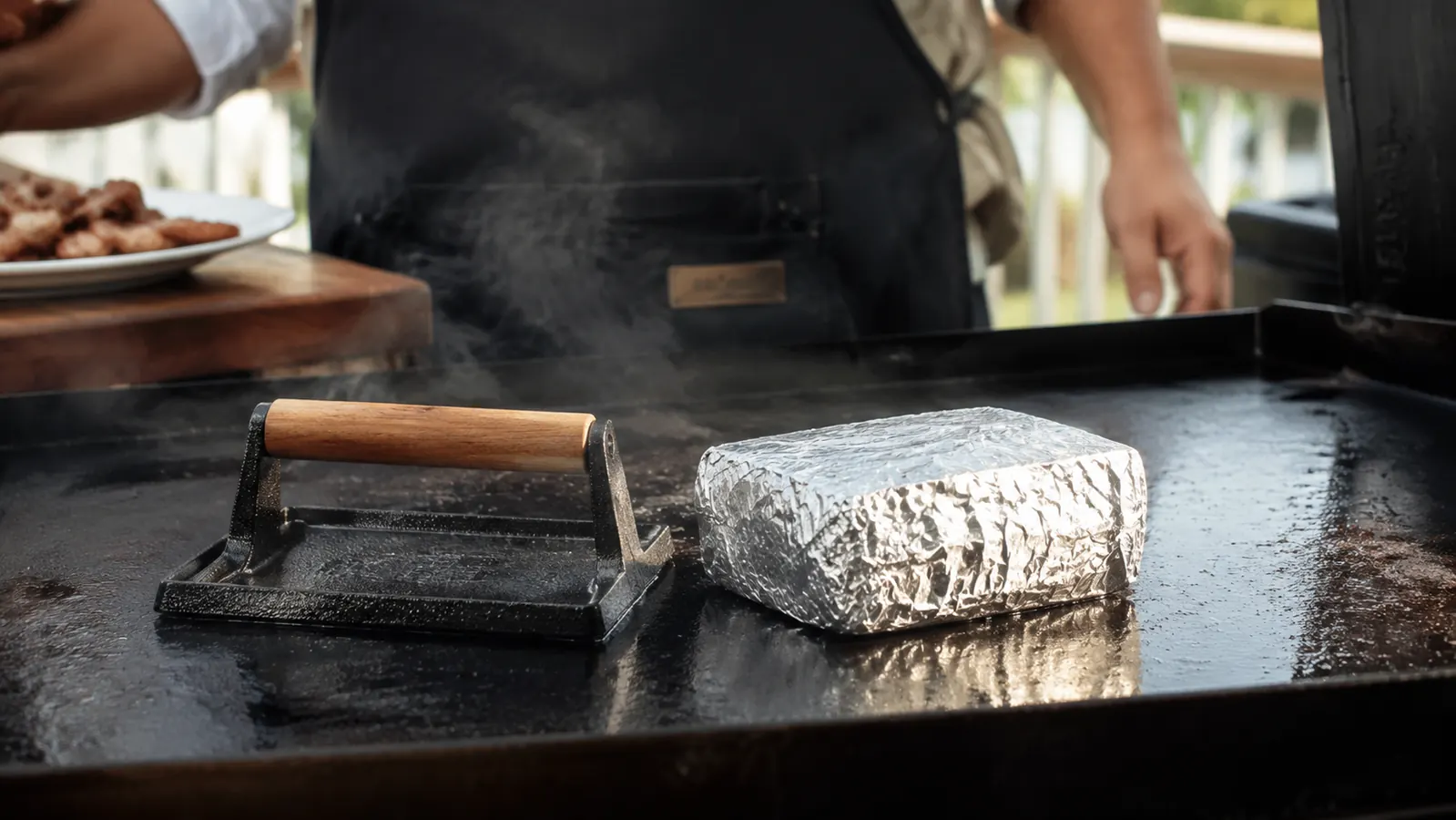
Every summer somebody at the cookout tells me the same thing: forget buying a proper press, just wrap a brick in foil and use that to smash your burgers flat on the griddle. I heard it again this spring from my brother-in-law Ronnie at my daughter's graduation party. I understood the thinking. A brick is free, it's heavy, and there's probably one sitting by the garden bed right now. But after two full grilling seasons running my Cuisinart cast iron grill press right alongside that same foil-wrapped brick on my own back patio, I can tell you plainly, they are not the same tool. One of them will let you down at the worst possible moment, usually right when a dozen hungry cousins are lined up at the picnic table waiting on their burgers.
So here's the short answer, then I'll walk you through exactly how I tested both. If you make smash burgers or crisp up bacon more than a couple times a month, the Cuisinart press earns its spot in the drawer and stays there for years. The foil-wrapped brick is a fine one-time experiment, or a backup when you're at a rental cabin with nothing else on hand, but I would not hand it to my daughter to use without watching close, because foil tears and bricks shed grit into the food a lot faster than you'd think. Below is the full breakdown, row by row, and then the real test I ran on my own griddle.
| Factor | Cuisinart Cast Iron Grill Press | Foil-Wrapped Brick |
|---|---|---|
| Price | Low-cost one-time buy, check today's price on Amazon | Free if you already own a brick, plus a roll of heavy-duty foil |
| Material | Solid cast iron, nonstick coating, wooden handle | Standard clay or concrete brick wrapped in aluminum foil |
| Weight & Balance | About 2 pounds, sized to press one to two patties evenly | Usually 4 to 5 pounds, weight sits unevenly across the patty |
| Heat Handling | Holds and transfers heat, helps sear a dark crust into the meat | Stays cool inside, the foil can scorch, tear, or fuse to the meat |
| Food Safety | Food-grade cast iron, dishwasher safe, no flaking into food | Foil shreds with repeated use, brick dust and grit can end up on your patty |
| Cleanup | Wipe down or hand wash, keeps its seasoning | Foil gets tossed after a few uses, brick needs re-wrapping every session |
| Durability | Built to last for years with basic care | Foil rips within a handful of cookouts, some bricks crack under direct heat |
| Best Use Case | Smash burgers, bacon, chicken breasts, grilled cheese, quesadillas | A one-off camping trip or a true emergency backup with nothing else around |
Where the Cast Iron Press Wins
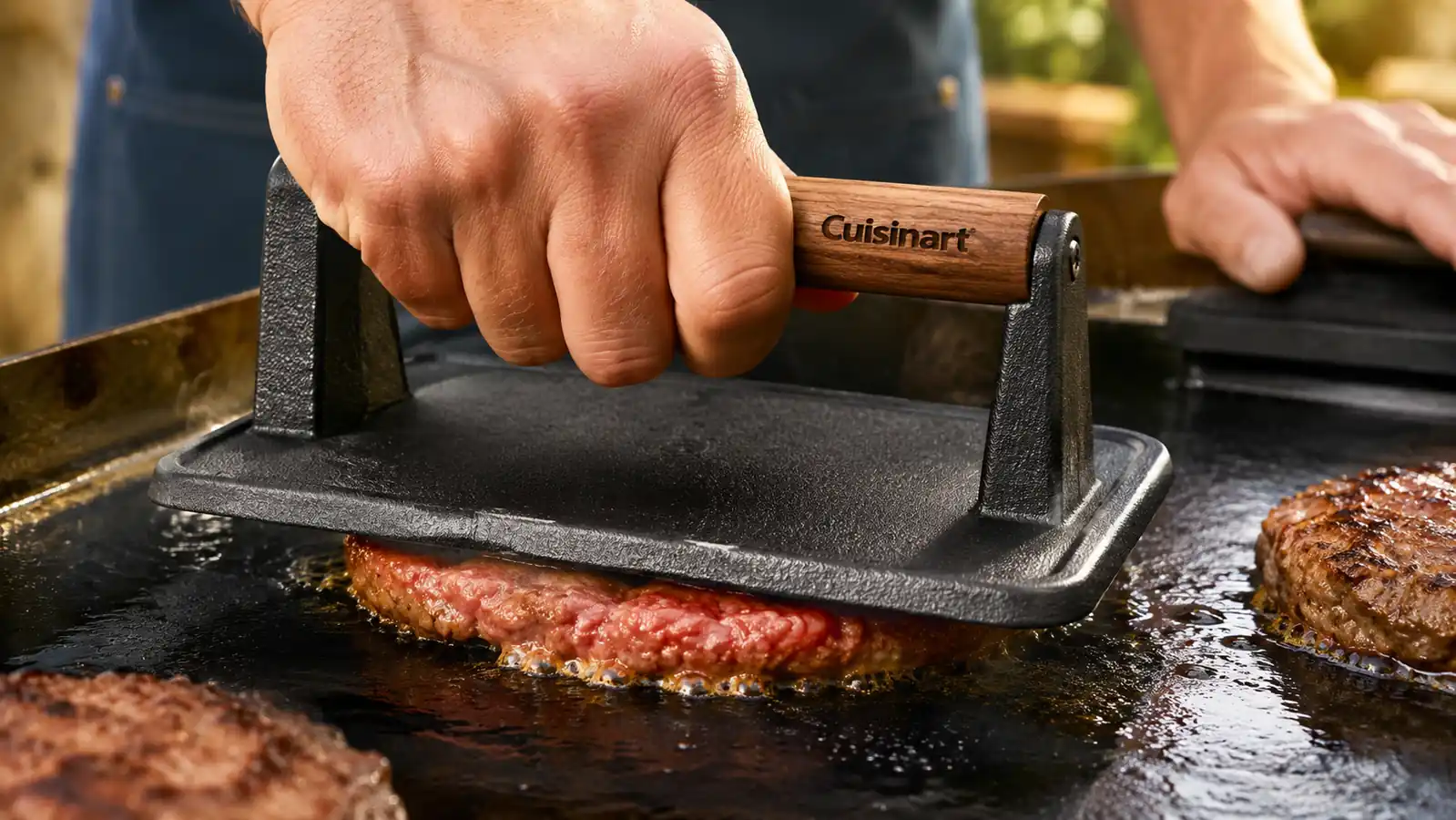
The first thing you notice with the Cuisinart press is the weight distribution. It's built flat and even, about 2 pounds, so when you set it down on a patty it presses the whole surface at once instead of tipping to one side the way a lopsided brick does. That even pressure is what gives you that lacy, dark crust all the way around the edge of a smash burger instead of a crust on one half and pink, un-seared meat peeking out the other. I make six-ounce balls of 80/20 ground chuck for my reunion crowd, and the difference between an evenly smashed patty and a crooked one shows up the second you flip it. Even pressure means even sear, and even sear is the whole point of smashing a burger in the first place.
The second win is heat. Cast iron holds heat and passes it straight into whatever it's pressing, which actually helps the sear along instead of fighting it. I've used mine to render down thick-cut bacon too, laying strips flat on the griddle and setting the press over the top so they cook flat instead of curling up into little canoes. A foil-wrapped brick, by contrast, stays cool in the middle the whole time. It's just dead weight. It'll flatten a patty, sure, but it does nothing to help the crust along, and I noticed my bacon curled up plenty when I tried the brick version.
The third win, and the one that matters most to me now that I've got grandkids running around the yard at these cookouts, is food safety. Cast iron with a nonstick coating wipes clean and goes in the dishwasher. A foil-wrapped brick, especially after its third or fourth use, starts to tear at the corners where the heat and the pressing wear through the aluminum. Once that happens you've got bits of foil, and sometimes actual brick dust, working their way into your food. I didn't think much of it until I found a small silver fleck stuck to a patty one Saturday, and that was the last time I used the brick for anything I planned on serving to family.
Where the Foil-Wrapped Brick Wins
I'll give the brick trick its due, because it does win on a couple of fronts. Cost is the obvious one. If you've already got a spare brick sitting around from a landscaping project, and a roll of heavy-duty foil in the drawer, you can be pressing burgers in the next five minutes without spending anything extra. That matters if you're testing out whether you even like smash burgers before committing to buying gear, or if you're feeding a crowd on short notice and don't have time to order anything.
It also wins on availability in a pinch. I keep a brick and a roll of foil in the shed at my sister's lake cabin for exactly this reason, because we don't keep a full set of grilling gear up there. When we show up for a weekend and somebody wants smash burgers off the flat-top, the brick gets us there without a special trip to the store. For that kind of occasional, low-stakes use, it does the job well enough, and nobody's going to complain about a burger that's 90 percent as good as the real thing when they're on vacation.
Where I'd stop short of recommending it is anything regular. The foil tears faster than people expect, usually by the third or fourth press, and once it tears you're re-wrapping the brick before your next batch, which eats into your cooking time right when the griddle's hot and everybody's hungry. It's a fine stopgap. It's not a tool I'd build a habit around.
Tired of Chasing Down a Foil Roll Every Cookout?
The Cuisinart cast iron press does the same job the brick trick promises, flatter patties, darker crust, flatter bacon, without the re-wrapping and without worrying about grit in your food. Check today's price and see why it's become the tool I actually reach for.
Amazon Check Today's Price on Amazon →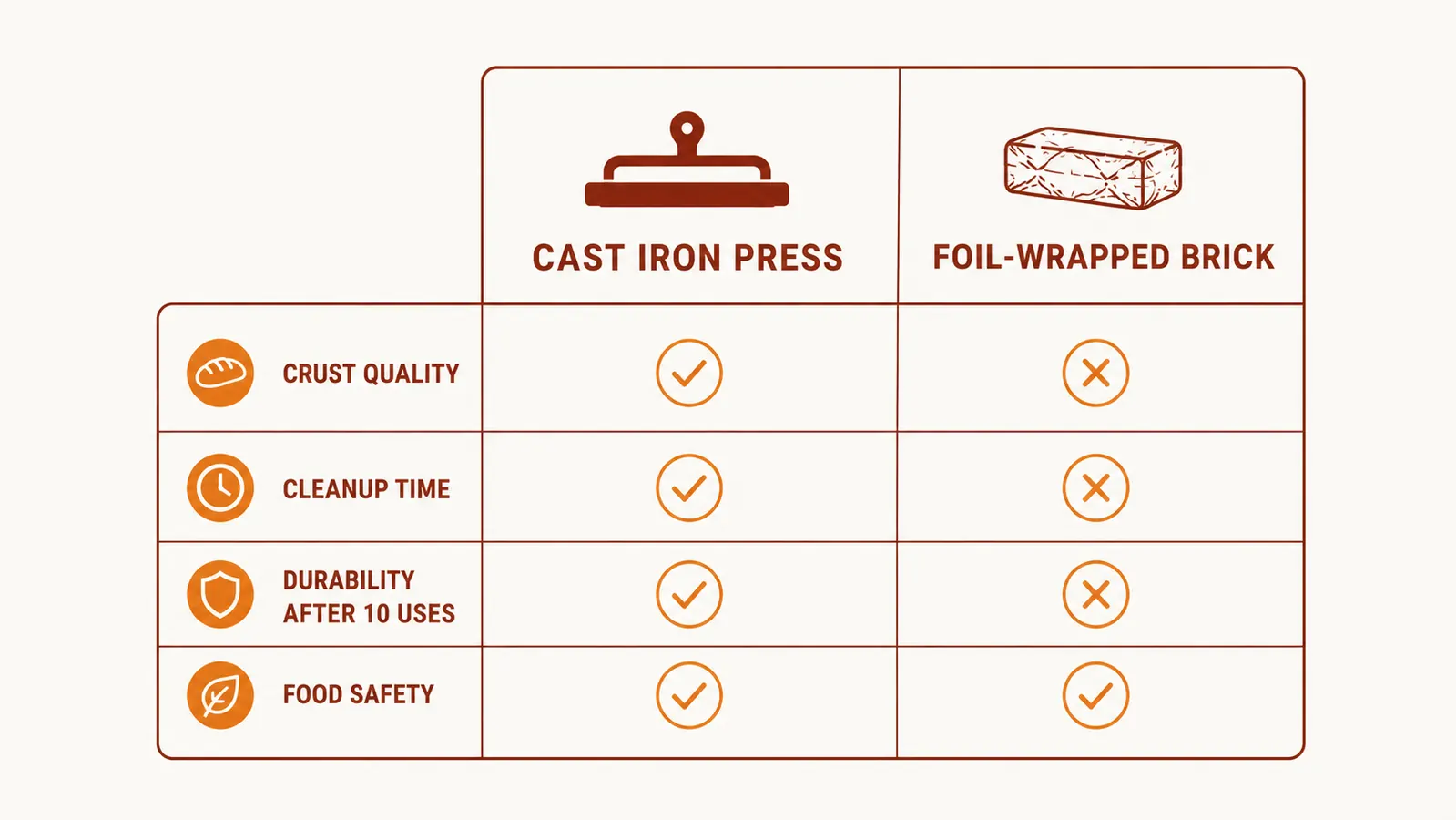
The Real Test: Six Smash Burgers, Two Methods
I didn't want to just tell you my opinion, so back in May I ran both tools on the same griddle, same night, same batch of meat. I split two pounds of 80/20 chuck into six four-ounce balls, three for the press and three for the brick. Griddle was preheated to right around 400 degrees on my flat-top, same spot on the surface for each batch so the heat was as close to identical as I could get it. Each ball got smashed the second it hit the griddle, thirty seconds under pressure, then left alone to build a crust for about two minutes before the flip.
The three patties under the Cuisinart press came out nearly identical, each one flattened to about a quarter inch thick with that dark, almost lacy crust running edge to edge. No thin spots, no torn meat where the pressure sat wrong. The three under the foil-wrapped brick were noticeably less even. Two of the three had a thicker rim on one side where the brick's weight had shifted slightly during the press, and the third one actually tore a little at the center where the foil had wrinkled and dragged against the surface of the patty instead of pressing it clean.
My wife Carol, who doesn't play favorites in these kitchen experiments, picked the press patties as the better bite without knowing which was which. Her exact words were that the press burgers had crust all the way through instead of just around the edges. That lined up with what I'd noticed watching them cook. When the pressure is even, the sear is even, and when the sear is even, the whole burger tastes like the crust instead of just the outside quarter inch of it.
I ran the same side-by-side with bacon a week later, six strips of thick-cut peppered bacon split evenly between both methods. The press held its strips flat against the griddle the whole cook, so every strip came out even and crisp edge to edge. Under the brick, two of the three strips curled up at the corners within the first minute because the brick's weight had shifted off center, and one strip stuck slightly to the foil where a small tear had opened up from the heat. Neither disaster was ruining anybody's breakfast, but it was one more small reminder that even weight and a flat surface matter more than raw pounds pressing down.
Cleanup, Storage, and Everyday Practicality
Past the cooking itself, the day-to-day difference is bigger than I expected going in. The Cuisinart press wipes down with a paper towel most nights, and every month or so I'll give it a real wash and re-season it lightly with oil, same as any cast iron pan. It hangs on a hook by my griddle station, ready to go the next time. The wooden handle stays cool enough to grab without a mitt most of the time, though I'd still recommend one if you're pressing something straight off high heat.
The brick, once its foil wrap is torn, is just a used brick again until you wrap it fresh. That means keeping a roll of heavy-duty foil on hand specifically for this, and taking a few minutes before each cookout to re-wrap it tight enough that it won't slip during the press. It's not hard, but it's one more small chore added to a cookout day that already has plenty of them, and it's exactly the kind of thing that gets skipped when you're rushing to get food on the table before the family shows up.
There's also the matter of consistency from one brick to the next. Not every brick is the same size or the same weight, so if you're borrowing one from a neighbor or grabbing whatever's sitting around the yard, you're never quite sure how it'll perform until you've already got meat on the griddle. The Cuisinart press is the same tool every single time, same weight, same flat surface, same result, whether I'm cooking for two or cooking for the whole church group after Sunday service.
Who Should Buy Which
If you're making smash burgers, bacon, or grilled cheese more than once or twice a month, get the Cuisinart press. It's a low-cost one-time buy that pays for itself the first time it saves you a burnt batch or a re-wrapped brick, and it'll still be doing the job two grilling seasons from now the same way mine has. If you're testing the waters on whether smash burgers are even your thing, or you need a one-time solution at a cabin or campsite with nothing else around, the foil-wrapped brick will get you through that single cookout without embarrassment. Just don't make it your everyday tool, and definitely don't use a brick that's already cracked or crumbling at the edges, foil wrap or not.
Make the Switch Before Your Next Cookout
Once you've pressed a burger with real cast iron, going back to a brick feels like a step backward. Grab the Cuisinart press and get consistent, dark crust on every patty, every time.
Amazon Check Today's Price on Amazon →