
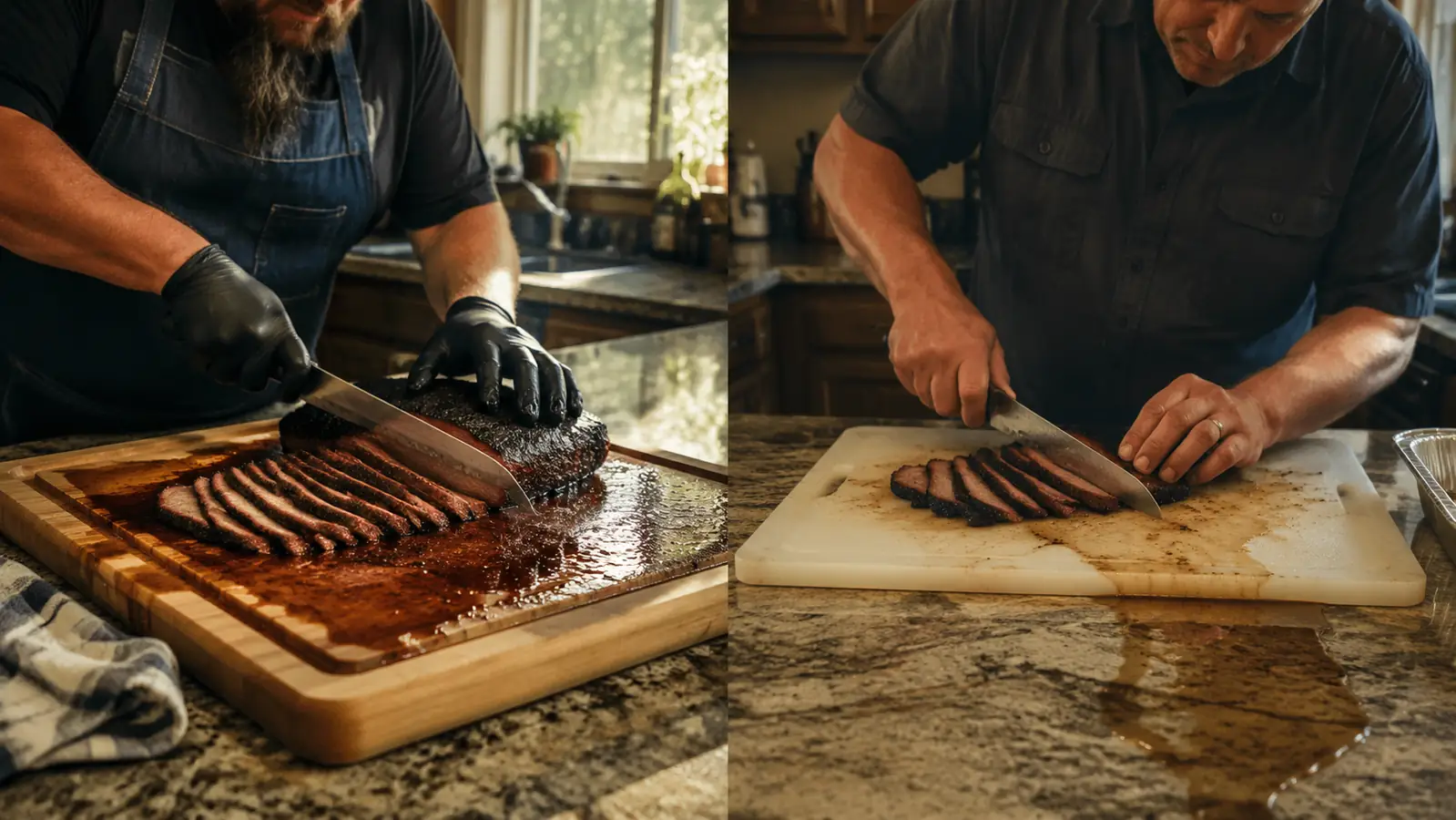
If you want the short answer before I get into the weeds, here it is. A wood carving board with a juice groove, like the ROYAL CRAFT WOOD bamboo board I keep next to my smoker, catches every drop of brisket juice and roast drippings that would otherwise run off a flat plastic cutting board and onto your counter. A plain plastic board wins on cost and on being safe to run through the dishwasher after raw chicken. For anything you're slicing after it comes off the smoker, meaning brisket, pork shoulder, a holiday turkey, or a Sunday pot roast, the wood board with the groove is the one I reach for every single time, and it's not close.
I didn't always think this way. For years I carved everything on the same beat-up plastic board I used for chopping onions, and I just accepted that carving a brisket meant a puddle on the counter and a paper towel roll standing by like a fire extinguisher. Then my daughter-in-law Renee bought me the ROYAL CRAFT WOOD board with the deep juice groove for Father's Day two years ago, half joking that I needed to "class up my carving station." I laughed it off in the moment, used it that same weekend on a fifteen-pound brisket for my son's thirty-fourth birthday, and never went back to slicing meat on plastic again. That one cookout changed my whole carving setup.
To be fair about how I tested this, I didn't just use the wood board a few times and call it done. I ran both boards side by side on the same brisket last month, cutting one half on the ROYAL CRAFT WOOD board and the other half on my old plastic board, same knife, same eight-minute rest, same kitchen counter. I wanted to see the difference for myself instead of just trusting my gut, and the difference showed up in about ninety seconds of slicing. I also ran the same test on a spiral ham at Easter and a fourteen-pound turkey at Thanksgiving, just to make sure the brisket result wasn't a fluke. It wasn't, and by the third test I stopped even bothering to set the plastic board out for anything bigger than a chicken breast.
One thing worth knowing going in, neither board is really wrong. They're built for two different jobs, and most kitchens I've been in over the years, including my own before Renee's gift, only have one board doing both jobs badly. Once you split the work between the two, carving stops being a mess to manage and just becomes part of the meal again.
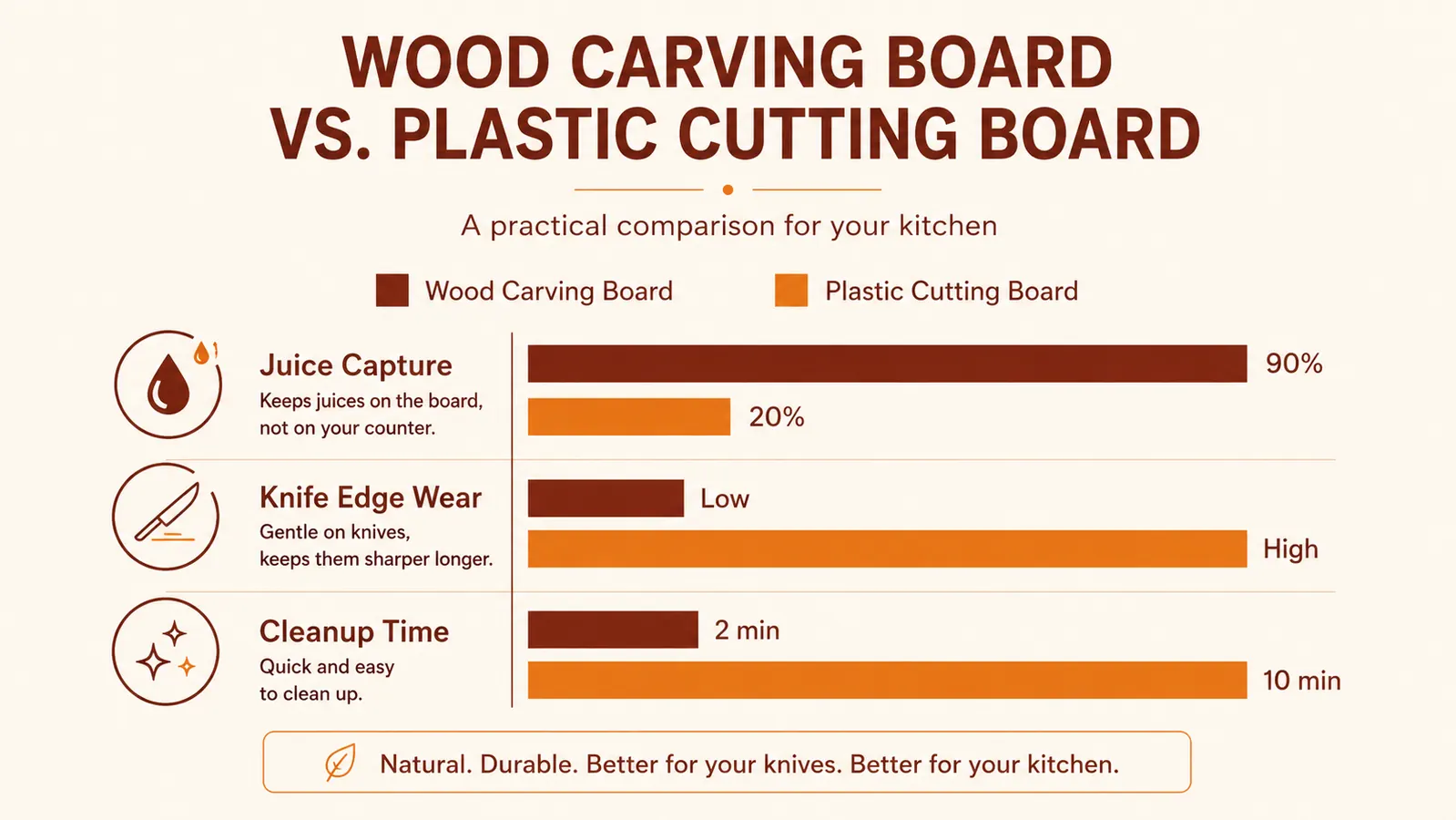
| Wood Carving Board | Plastic Cutting Board | |
|---|---|---|
| Board | ROYAL CRAFT WOOD Bamboo Carving Board | Standard Plastic Cutting Board |
| Juice Capture | Deep juice groove holds up to a full cup of drippings | Flat surface, juice runs off the edges |
| Best Use | Carving brisket, roasts, turkey, ham after resting | Everyday chopping, raw poultry prep |
| Knife Edge Wear | Gentle on blade edges, softer bamboo surface | Harder surface dulls knife edges faster over time |
| Weight & Stability | Heavy, sits solid on the counter without sliding | Lightweight, tends to shift during firm cuts |
| Cleaning | Hand wash and oil occasionally, not dishwasher safe | Dishwasher safe, no maintenance needed |
| Odor & Stain Resistance | Bamboo naturally resists odor buildup | Can hold onion and garlic smells over time |
| Handles for Carrying | Built-in side handles for lifting a loaded board | No handles, awkward to move once loaded with juice |
| Table Presentation | Looks like a real serving board at the table | Looks like a prep tool, not for the table |
Where the Wood Carving Board Wins
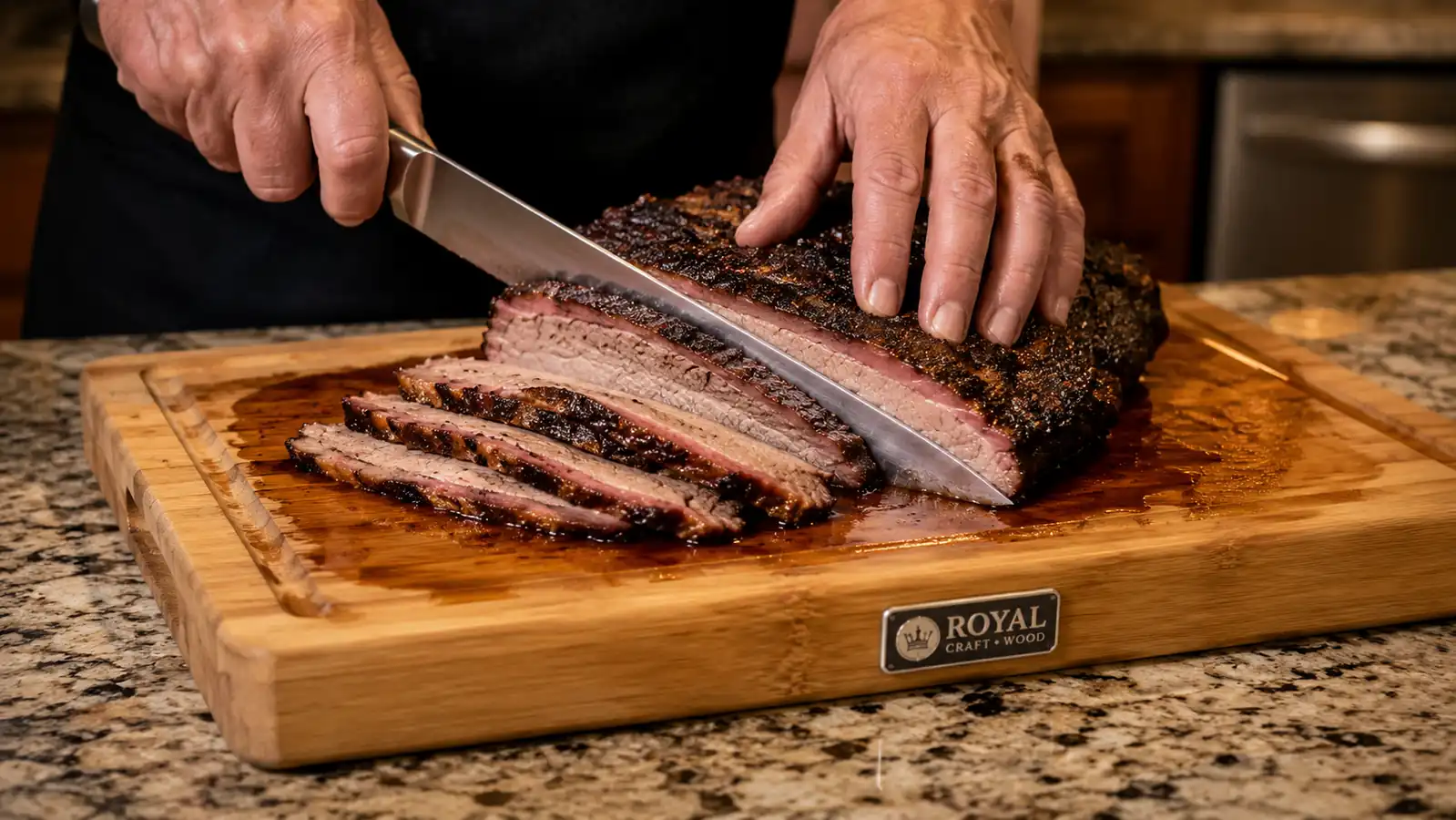
The juice groove is the whole reason this board earns its spot. When I pull a brisket off my offset smoker after twelve or thirteen hours and let it rest under foil, there's still a good amount of liquid fat and juice that wants to run out the second I start slicing. On a flat plastic board, that juice heads straight for the edge and drips onto the counter, sometimes onto the floor if I'm not paying attention, and my kitchen floor has the stains to prove it from years back. On the ROYAL CRAFT WOOD board, that same juice pools right there in the groove around the meat instead of running anywhere. I've measured close to a cup of drippings collected after carving a full packer brisket, and instead of wiping it up with paper towels, I spoon it right back over the sliced meat or save it in a mason jar for burnt ends the next day. That's flavor I used to just throw away without even thinking about it.
The weight and the side handles matter more than I expected too. This board is heavy enough that it doesn't skate around on the counter when I'm pressing down through a thick cut of brisket flat, which used to happen constantly with my old plastic board on a smooth granite counter. And when the board's loaded up with a whole turkey and a good bit of drippings after Thanksgiving dinner, those built-in handles let me carry the entire thing from the kitchen island to the dining room table without spilling a drop. My wife Carol noticed that part before I did. She said it was the first year in a decade nobody had to grab a rag and wipe up a trail of turkey juice between the counter and the table, and she's not one to exaggerate.
There's also a presentation side to it that I didn't expect to care about. When I set this board down at a church potluck with a smoked ham already sliced and sitting in its own juice, people notice. Somebody always asks where I got the board, and a few have asked if I made it myself. That's not something a scarred-up plastic cutting board is ever going to pull off at a serving table, no matter how clean you get it. My pastor's wife asked me about it at last spring's potluck, and I ended up sending her the same board as a birthday gift a few months later.
I'll add one more thing I didn't expect. The bamboo surface has been gentler on my knife edges than the plastic board ever was. I sharpen my slicing knife less often now, maybe every six weeks instead of every three, and I chalk that up to the softer wood surface not chewing up the edge the way a harder plastic board does over hundreds of cuts.
After two years of near-weekly use, mine still looks respectable. A little darkened from the oil and the years, but no cracks, no warping, nothing close to falling apart. I oil it maybe once every four to six weeks with plain food-grade mineral oil, and it soaks it right up. My old plastic boards, by comparison, would show deep knife grooves within a year that started holding onto smells no matter how well I scrubbed them. This one's held up better than I expected for something that started as a Father's Day gag gift.
Where the Plastic Cutting Board Wins
I'm not going to pretend plastic doesn't have its place, because it does, just not for carving. When I'm breaking down raw chicken thighs or chopping a pile of onions and jalapenos for a batch of BBQ baked beans, I grab the plastic board every time. It goes straight into the dishwasher afterward, no hand washing, no oiling, no worrying about bacteria soaking into end grain overnight. For raw meat prep specifically, that's genuinely the safer, easier choice, and I'd tell anyone the same without hesitation.
Plastic also wins on cost and on not needing any upkeep at all. You can buy one, use it hard for years, replace it when it gets too scarred up with knife grooves, and never think twice about it in between. The ROYAL CRAFT WOOD board needs an occasional coat of food-safe mineral oil to keep the bamboo from drying out and cracking, which isn't a big chore, maybe once a month if you're using it regularly, but it is one more small thing to remember. If you just want a board to chop vegetables on and don't care about catching any juice, a basic plastic board does that job fine without asking anything extra of you.
Plastic is also lighter and easier to store, which matters if your kitchen is short on counter space or cabinet room. My old plastic board slides into a narrow slot next to the stove without any thought. The ROYAL CRAFT WOOD board is bulkier and heavier, so it needs its own spot, usually leaning against the backsplash where I can grab it fast on a cook day. If you're tight on kitchen storage, that's a real consideration, not just a small one.
And honestly, if all you cook is quick weeknight meals, chicken breasts on the stovetop, a fast stir fry, sandwiches for the kids' lunches, you may never even need a carving board. Plastic handles that kind of everyday kitchen work just fine, and there's no reason to spend on something you'd only pull out a few times a year.
Stop losing brisket juice to your kitchen counter
The ROYAL CRAFT WOOD carving board's juice groove holds a full cup of drippings instead of sending it onto your floor. Grab one before your next smoke day.
Amazon Check Today's Price on Amazon →
Who Should Buy Which
If you smoke or roast meat regularly, brisket, pork shoulder, a holiday ham or turkey, the wood carving board earns its keep fast. It's not really competing with your everyday cutting board, it's solving a different problem, which is what to do with all that juice once the meat comes off the heat and gets sliced. Keep your plastic board around for raw prep and daily chopping, and set the wood carving board aside just for the moment the meat is ready to be sliced and served. That's exactly how I run my own kitchen now. Plastic board for prep work during the week, the ROYAL CRAFT WOOD board comes out the second something finishes resting under foil. Two boards, two jobs, and my counter stays a lot cleaner than it used to, which my wife will confirm without me even asking her to.
If you host holidays, run a smoker on weekends, or bring meat to church potlucks and family reunions like I do, I'd put the carving board near the top of your list. If your cooking mostly happens on a stovetop or in a skillet and you rarely carve anything bigger than a chicken breast, save your money and stick with plastic. Neither choice is wrong, it just depends on what's actually landing on your cutting surface most weekends. For me, after two years and more brisket cookouts than I can count on both hands, the wood board earned its permanent spot next to the smoker, and that's not changing anytime soon.
Give your next brisket the board it deserves
One board with a real juice groove and side handles for carrying it loaded to the table. It'll change how you carve for good.
Amazon Check Today's Price on Amazon →